


Angels in Ceremonial Magic: Planetary Powers, Sacred Names and the Enduring Appeal of Magical Amulets

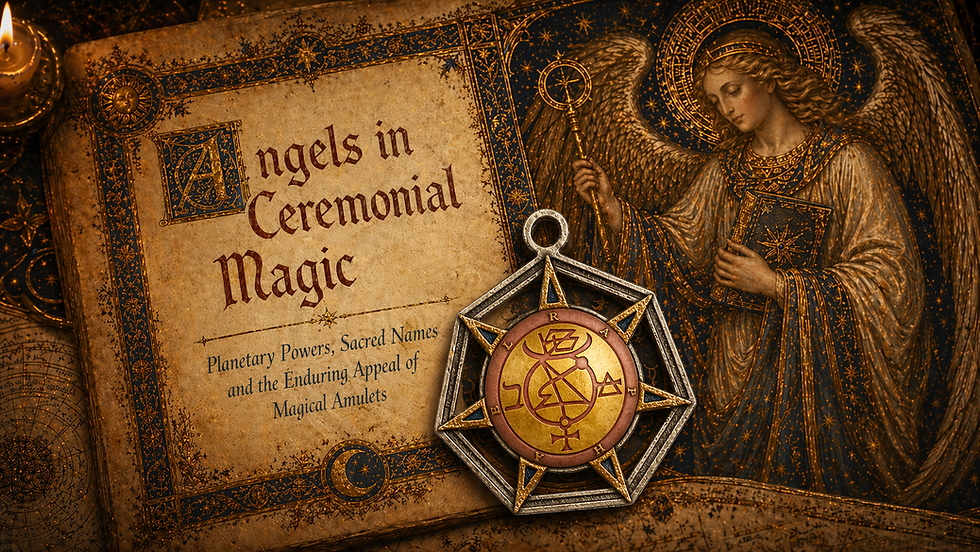
There is a particular kind of magic that does not begin in the forest, but in the study.
It begins by candlelight, with a page of diagrams, a table of correspondences, a careful eye on the heavens, and the conviction that the universe is not random, but ordered. In the world of medieval and Renaissance ceremonial magic, angels were part of that order. They were not simply comforting heavenly figures in the modern sentimental sense. They were intelligences of rank, power and office, woven into a cosmos of planets, elements, divine names, sacred timings and spiritual hierarchy.
That is part of what makes angelic symbolism so enduringly compelling. It carries with it the atmosphere of high magic: learned, structured, reverent, and a little dangerous around the edges. It suggests that symbols are not there merely to decorate, but to connect. A name, a seal, a planetary sign, a metal, a day, an hour: each thing belongs to something larger.
Angels and the ordered cosmos
To medieval and Renaissance magicians, the cosmos was alive with correspondence. Planets were not just astronomical bodies. They were sources of influence, meaning and spiritual character. Around them grew a language of alignment: certain days, colours, metals, prayers, perfumes, images and names belonged more properly to one force than another. In this system, angels often appeared as rulers, governors or sacred intelligences associated with the seven planetary powers. Texts such as the Heptameron and Agrippa’s Three Books of Occult Philosophy preserve these associations, while also showing that names and attributions could vary across traditions and manuscripts.
That variation is part of the charm, not a flaw. Ceremonial magic was never one neat universal spreadsheet. It was a living body of practice, borrowing from theology, astrology, late antique cosmology, Hebrew angelology and grimoire tradition. What remained consistent was the idea that sacred names mattered, that the heavens had structure, and that spiritual forces could be approached through disciplined symbolic means.
The seven planetary angels
Among the most enduring angelic figures in ceremonial magic are the seven planetary angels. In later magical tradition, they are often paired with the seven classical planets and their distinct qualities. The names most familiar to modern readers are Cassiel, Sachiel, Samael or Zamael, Michael, Anael, Raphael and Gabriel, though spellings and exact correspondences can shift depending on the source. Agrippa records both a Hebrew-derived set of planetary angel names and an alternative set of planetary “intelligences,” while related grimoire traditions such as the Heptameron helped stabilise a widely recognised sequence used well beyond the medieval period.
This is the sequence reflected in our Medieval Magickal collection:
Cassiel, Angel of SaturnA figure of gravity, contemplation and limits. Saturn is the planet of boundaries, endurance, discipline, age, wisdom and the difficult strength that comes from restraint. A Saturnian angelic amulet carries a beautiful severity to it, protective in a quiet, iron-spined way.
Sachiel, Angel of JupiterJupiter expands where Saturn contracts. Traditionally associated with prosperity, justice, authority, generosity and benevolent increase, Sachiel belongs to the more fortunate and kingly side of ceremonial symbolism. This is one of the great angels of blessing, breadth and noble confidence.
Zamael, Angel of MarsUnder Mars we find force, action, courage and the heat of conflict. Whether written as Samael or Zamael in different traditions, this angelic current carries the sharper edge of will, protection, struggle and decisive movement. A martial amulet is never timid.
Michael, Angel of the SunIn many later magical systems, Michael is linked with solar power: illumination, courage, vitality, authority and triumph. The solar current is radiant rather than soft. It clarifies, strengthens and reveals. It is the splendour at the centre.
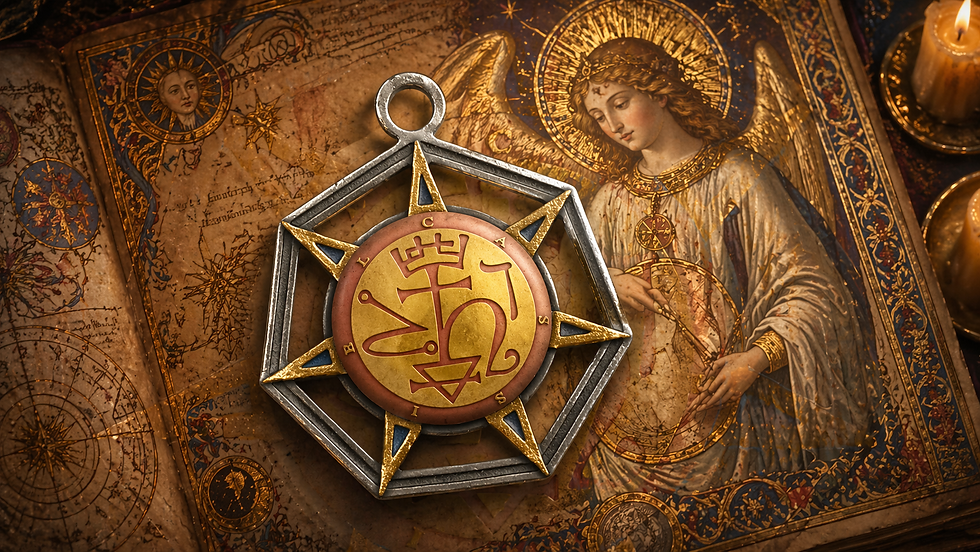
Anael, Angel of VenusVenus governs beauty, harmony, attraction, pleasure and affection. Anael brings grace to the planetary scheme, but not triviality. In magical symbolism, Venus is not just romance. It is concord, sweetness, artistry and the power that draws things together.
Raphael, Angel of MercuryMercury belongs to speech, intellect, learning, movement, writing and subtle skill. Raphael, in this context, is the quicksilver intelligence: the angel of wit, transmission, study and eloquence. It is no surprise that Mercurial symbolism still appeals so strongly to readers, writers and seekers of knowledge.
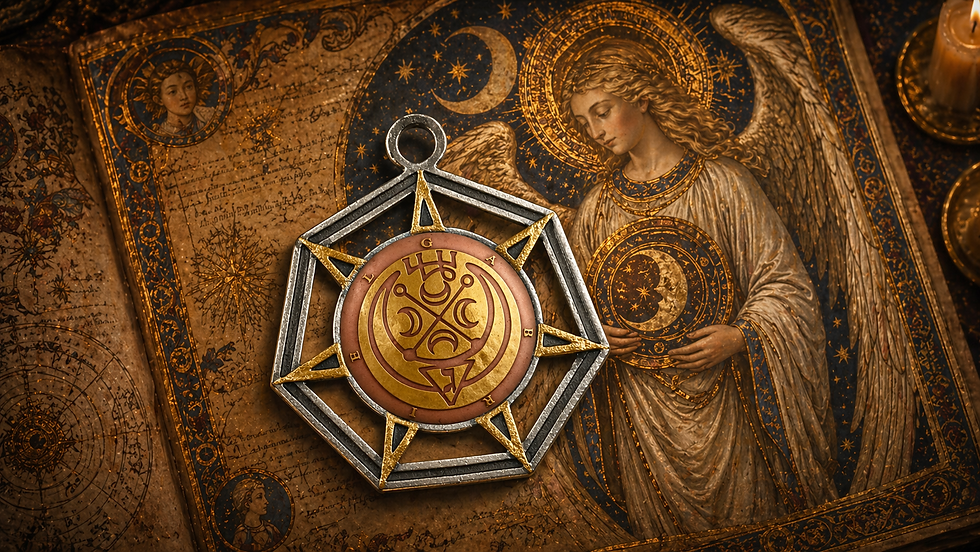
Gabriel, Angel of the MoonThe Moon rules change, intuition, dreams, reflection, receptivity and the hidden tides of inner life. Gabriel’s place in magical thought is full of depth and atmosphere. Lunar symbolism often feels the most intimate: inward, shifting, mysterious and quietly powerful.
More than planets: angels, elements and sacred direction
Ceremonial magic did not stop at the seven planets. Agrippa also discusses angels associated with signs, lunar mansions, winds, quarters of the world and even the elements themselves. That broader framework helps explain why angelic magic feels so rich: it imagines a universe saturated with hierarchy and relation, where heaven, time, direction and matter are tied together through symbol.
That wider logic also helps modern readers understand why magical amulets have such staying power. Historically, amulets and talismans were not mere trinkets. They were worn, carried or placed in order to protect, attract, align or invoke. Britannica notes that amulets were believed to protect or bring good fortune, while the Met shows that in multiple traditions talismanic objects gained force from sacred names, holy figures, astrological signs and ritually meaningful inscriptions.
Why angelic amulets still captivate now
Modern people may not all speak the language of planetary hours and celestial hierarchies, but the appetite behind these objects has not disappeared. We still want tokens of courage, clarity, protection, vitality, love and hope. We still respond to symbols that feel older than ourselves. We still like the sense that an object might do more than sit prettily on a shelf.
That is why angelic and planetary amulets continue to resonate so strongly today. They offer beauty, certainly, but also structure and meaning. They suggest that the wearer is not choosing at random, but in sympathy with a quality, a force, an intention or a story. They belong to the same enduring family as the medieval talisman, the inscribed seal and the celestial diagram: objects that make visible the dream of hidden order.
The Medieval Magickal collection
Our Medieval Magickal range draws directly on that world of sacred names, planetary symbolism and ceremonial atmosphere. The collection brings together the seven planetary angels alongside elemental powers, translating old magical ideas into wearable emblems that feel both historical and alive. Each piece carries its own symbolic character, but together they form a coherent magical cosmos: Saturn and discipline, Jupiter and blessing, Mars and courage, the Sun and radiance, Venus and harmony, Mercury and learning, the Moon and intuition.
For shops whose customers are drawn to mystical, spiritual and symbolic design, this kind of collection offers something especially rewarding. Not just jewellery, but jewellery with lineage. Not just decoration, but a story. And in the case of ceremonial angelic symbolism, a story written in stars, names and firelit pages.


Comments